
 Written by Laurence Marvin S. Castillo
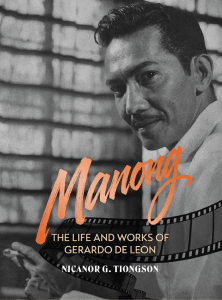
Nicanor Tiongson’s Manong: The Life and Works of Gerardo de Leon (2025), published by the University of the Philippines Press, is a fitting tribute to the cinematic legacy of National Artist for Film Gerardo De Leon. In this new book, Tiongson demonstrates the encyclopedic grasp of Philippine cultural history and archival rigor that have long marked his body of scholarly works, traits that are here enlisted to shed light on and examine the indispensable contributions of one of Philippine cinema’s pioneering masters.
The book opens with “Early Years: 1913-1938,” tracing the genealogy of De Leon to the influential Ilagan clan, which counts among its members Hermogenes “Moneng” Ilagan, De Leon’s father and a descendant of Francisco Baltazar. Known as the “Father of the Philippine Sarsuwela,” Moneng Ilagan emerges as a compelling character in this biographical account, casting a shaping force on his children’s subsequent creative engagements and instilling in them the necessary discipline and ethical principles in theater work and eventually filmmaking. The detailed chronicle of Ilagan’s artistic influence on his children brings to the fore the interaction between familial intimacies and creative labor in giving shape to the country’s cultural production, providing some insights into how collaborative artistic practices are enmeshed in the tightly-knit family dynamics in the country. In recounting the family’s involvement in theatrical productions which would extend to their eventual venture into filmmaking, the chapter also shows the close link between theater and the development of the then emergent cinematic practice in the Philippines.
In chronicling De Leon’s formative years, the book vividly conjures the social dynamics of early twentieth century Philippines, and the prevailing intellectual and cultural environment, in which the director came of age. In the mentioned chapter, Tiongson also takes note of the spheres of cultural exposure, particularly the moviehouses in Manila, during the 1900s, through which De Leon was able to gain further understanding of artistic practice, apart from the experiences made available to him by virtue of his family’s involvement in theater. These intellectual and cultural influences were complemented by his own pursuit of medical education, which provided him a scientific outlook in his subsequent work, and allowed him to imbue his cinematic creations with psychological insights.
Tiongson also locates, in the same chapter, De Leon’s creative growth not just in his practical engagement as an actor, but also in his efforts at self-education. De Leon continued his cultural pursuits, at some point playing piano to provide live accompaniment to silent films, and actively sought out foreign films that entered the country. Such an eclectic cultural exposure enabled him to develop his understanding of cinematic styles and aesthetic principles that would prove useful in his own later productions. Tiongson synthesizes the intellectual and cultural discourses, ideological themes and stylistic qualities that mark the works and texts that the auteur was exposed to — from cinematic masters like Sergei Eisenstein, Yasujiro Ozu and Satyajit Ray to thinkers like Georges Bataille. These extensive influences would be crucial in shaping De Leon’s own generically and thematically diverse cinematic practice.
Taking up the bulk of the volume is the discussion of the filmography of De Leon. Across seven chapters, which cover De Leon’s filmic outputs from his early works in Parlatone and LVN, R-D-R, and Sampaguita in the late 1930s, his wartime filmography, his postwar works under Sampaguita and Premiere to his forays in both independent and commercial productions in the 1960s to the 1970s, Tiongson chronologically traces the auteur’s diverse body of cinematic works, tracking their respective production contexts and collaborative environments and conditions. The chapters contain film synopses, production information and even details about the critical reception that the works generated. Tiongson’s careful contextualization reveals De Leon’s filmography to be borne out of the various concessions and maneuvers that the director engaged in to negotiate with studio demands while maintaining artistic independence. Grappling with the dialectical dynamics between autonomy and intervention as he worked with studios like Sampaguita Pictures and Premiere Productions while developing his own cinematic vocabulary, De Leon produced a formidable body of work marked by stylistic and narrative diversity, honing his craft in every production, be it one that complies with the imperatives of popular entertainment or one more invested with arthouse ambitions.
In undertaking such a comprehensive effort at documenting De Leon’s cinematic outputs, Tiongson has to contend with the archival problems that hound culturalhistorical research in the country. Of De Leon’s roughly sixty films, only twenty two are extant. To address the limitations posed by such archival problems, Tiongson fills in the void by turning to other resources like komiks, novels and newspaper clippings to reconstruct the narratives and other significant details of the auteur’s lost films.
Drawing on these existing documents allows Tiongson to approximate lost details and make conjectures about the public impact of, and response to, these works. This creative extrapolation also allows Tiongson to emphasize Philippine cinema’s entanglement with other art forms like theater, literature and komiks. By bringing to light how De Leon reimagined narratives drawn from non-filmic mediums, Tiongson’s book reveals the wealth of intertextual borrowings and reconfigurations that mark film production in the country. At the same time, as some of these productions like the fantasy film Dyesebel (1953) were borne out of perceived popular clamor for movie versions of popular literature, what is revealed is how creative decisions about narrative and generic choices for film production are shaped to a significant degree by studio-dictated notions of popular taste and demands.
The reader is hence given a concrete portrait of the vibrancy of creative work from the pre-war era, palpable in De Leon’s chameleon-like studio work, his dynamic responses to the changing political climate, and the artistic collaborations that he forged with established and emerging stars and production crew. Across the painstaking reconstruction of De Leon’s development as a towering figure in Philippine cinema who polished his craft in and through every project he created, Tiongson gives his own insightful comments on the aesthetic features and stylistic innovations of De Leon’s filmic works.
Attentive to the imperatives of historicizing cultural work, Tiongson’s discussion of De Leon’s filmography takes careful consideration of the shifting landscape of Philippine politics and society, especially at a highly volatile milieu marked by American colonial tutelage, wartime atrocities, and post-independence challenges. De Leon’s development as an artist is marked by the ways in which creative decisions and choices were shaped not just by studio demands, but also by the political pressures of his time. For instance, in “Chapter III. The War Years: 1942- 1945,” Tiongson offers a nuanced account of the pressures that impelled De Leon to create propaganda films like 1944’s Dawn of Freedom for the Japanese colonizers during the Second World War. The author examines wartime circumstances under which De Leon labored, clarifying the director’s own political stance as a filmmaker forced to do work for colonial propaganda, while also continuing clandestine involvement in a guerrilla organization.
The book emphasizes that examining auteurial agency in creative work requires a profound understanding of how biographical circumstances are embedded in specific socio-historical conditions. Tiongson’s task of laying bare and examining the political visions underlying De Leon’s work involves a nuanced accounting of the conjunctural and the structural conditions under which artists labor. A fascinating episode that Tiongson fleshes out towards the end of “Chapter IV: Sampaguita Pictures: 1946-1947” is De Leon’s vehicular accident in 1947, which was a crucial event that heralded a new phase in the director’s filmic work. De Leon’s Damascus moment compelled him to elevate his artistic ambitions and articulate nationalist sentiments in his work. Imbued with a renewed sense of direction to create meaningful and socially relevant work, De Leon’s commitment to nationalist politics would become pronounced in the following years which would see him producing masterworks that explicitly tackle social concerns like Sisa (1951) and Ang Daigdig ng mga Api (1965).
In synthesizing the director’s body of work, Tiongson offers his own assessment of the various elements of De Leon’s work, his professed admiration for the director never getting in the way of nuanced, occasionally candid, evaluations of some of the films discussed in the book. Apart from a careful examination of the technical aspects of the director’s films like editing, screenplay and visual style, the book’s penultimate sections deepen the readers’ appreciation of De Leon as a flesh-andblood artist through discussions of his political and ideological convictions, his work style and interactions with his artistic collaborators. Tiongson offers a cogent synthesis of the diverse themes in De Leon’s filmography, exploring the personal attitudes and relatively progressive disposition that the auteur held concerning nationalism, social reform, and even gender and sexuality, as they are conveyed in and through his films. The book also gives space to De Leon’s frank views about the film industry’s transformations, and the emergence of younger auteurs like Ishmael Bernal and Lino Brocka, casting light on his hopes and dreams for the fate of the art form to which he devoted his life. De Leon’s insights about these industry developments could further be extended to an elaborate discussion of the influence that the older auteur’s works would cast upon the aesthetic and political achievements of the Second Golden Age of Philippine cinema.
One comes away from the book rewarded by the richly detailed examination of an artist who ventured into filmic work at a time when the country was confronted with the challenges of multiple colonial legacies and post-independence concerns. The book concludes with photographs that serve as a visual archive of De Leon’s stellar filmmaking career. In this pictographic gallery, the readers are able to glimpse into the workings of the master, whose works demand to be appreciated by the younger generations of scholars, filmmakers and audiences, despite the archival lacunae. Also included is De Leon’s detailed filmography, which contains important information that can be used for future research. In assembling this important tribute to the National Artist, Tiongson, reaffirming his stature as one of our foremost cultural historians, accomplishes the essential task of documenting the legacy of one of Philippine cinema’s original masters for a new generation of readers and cinephiles.
This feature article is from Saliksik: UPD Journals Online. Text by Laurence Marvin S. Castillo.
Published by: Research Dissemination Office HD
Disciplinary: Humanities
ISSN: 2012-0788