Posted on

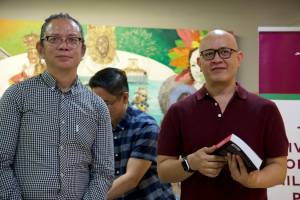
UP Press Wins Publisher of the Year!


According to the National Book Development Board, “We honor the University of the Philippines Press as one of the Publishers of the Year at the 42nd National Book Awards (NBA), where its take on independent cinema, children’s literature, the politicization of the personal, and the power of deep introspection rendered in poignant poetry have been deemed not only excellent but necessary additions to the country’s growing publishing landscape.”


Seven (7) UP Press titles are big winners in the 42nd NBA—
1. 𝐁𝐄𝐒𝐓 𝐁𝐎𝐎𝐊 𝐎𝐅 𝐍𝐎𝐍𝐅𝐈𝐂𝐓𝐈𝐎𝐍 𝐏𝐑𝐎𝐒𝐄 𝐈𝐍 𝐅𝐈𝐋𝐈𝐏𝐈𝐍𝐎: Patining at Iba Pang Sanaysay ni Soliman A. Santos. (The Philippine Writers Series 2023)
2. 𝐁𝐄𝐒𝐓 𝐀𝐍𝐓𝐇𝐎𝐋𝐎𝐆𝐘 𝐈𝐍 𝐅𝐈𝐋𝐈𝐏𝐈𝐍𝐎: Bata, Hiwaga, Bansa: Pamana ni Rene O. Villanueva sa Panitikang Pambata nina Eugene Y. Evasco at Cheeno Mario M. Sayuno
3. 𝐁𝐄𝐒𝐓 𝐁𝐎𝐎𝐊 𝐎𝐍 𝐌𝐄𝐃𝐈𝐀 𝐒𝐓𝐔𝐃𝐈𝐄𝐒: Ang Mahaba’t Kagyat na Buhay ng Indie Sinema nina Rolando B. Tolentino at Aristotle J. Atienza
4. 𝐕𝐈𝐂𝐓𝐎𝐑𝐈𝐎 𝐂. 𝐕𝐀𝐋𝐋𝐄𝐃𝐎𝐑 𝐏𝐑𝐈𝐙𝐄 𝐅𝐎𝐑 𝐁𝐄𝐒𝐓 𝐁𝐎𝐎𝐊 𝐎𝐅 𝐏𝐎𝐄𝐓𝐑𝐘 𝐈𝐍 𝐅𝐈𝐋𝐈𝐏𝐈𝐍𝐎: Turno Kong Nokturno: Mga Bago at Piling Tula ni Lamberto E. Antonio. (The Philippine Writers Series 2023)
5. 𝐁𝐄𝐒𝐓 𝐓𝐑𝐀𝐍𝐒𝐋𝐀𝐓𝐄𝐃 𝐁𝐎𝐎𝐊 𝐈𝐍 𝐄𝐍𝐆𝐋𝐈𝐒𝐇: Húbad: Ester Tapia translated by Merlie M. Alunan. (The Philippine Translators Series 2021)
6. 𝐁𝐄𝐒𝐓 𝐁𝐎𝐎𝐊 𝐈𝐍 𝐒𝐂𝐈𝐄𝐍𝐂𝐄: Wild City: A Photographic Guide to Amphibians, Mammals, and Reptiles of Metro Manila by Jelaine Gan, Trinket Constantino and Abby Favis
7. 𝐇𝐈𝐋𝐀𝐑𝐈𝐎𝐍 𝐀𝐍𝐃 𝐄𝐒𝐓𝐇𝐄𝐑 𝐕𝐈𝐁𝐀𝐋 𝐏𝐑𝐈𝐙𝐄 𝐅𝐎𝐑 𝐁𝐄𝐒𝐓 𝐁𝐎𝐎𝐊 𝐈𝐍 𝐉𝐎𝐔𝐑𝐍𝐀𝐋𝐈𝐒𝐌: View from the Foxhole: Shaping the Political into the Personal by Joel Pablo Salud
Eighteen (18) UP Press titles were also considered finalists in this year’s awards.
UP Press Director Galileo Zafra in his speech acknowledged all those who contributed to this recognition as UP Press fulfills its mandate to publish for the nation.
Special Sale on UP Press Award-Winning Titles!
To Celebrate the 42nd National Book Awards Winners
• 20% OFF: Shop online at UP Press Shopee and Lazada stores (Dec 1–15, 2024).
• 30% OFF: Visit the UP Press Diliman Campus Bookstore (Dec 2–6 & Dec 9–13, 2024).
Plus, enjoy discounts of up to 20% OFF on other titles! Don’t miss out!
Posted on

The UP Press at the 2024 Manila International Book Fair

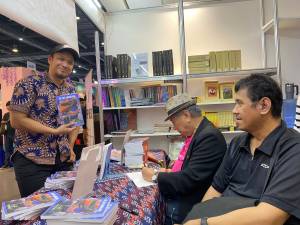
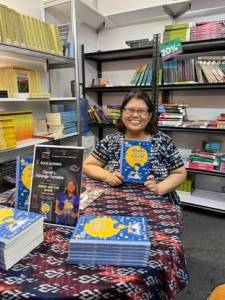
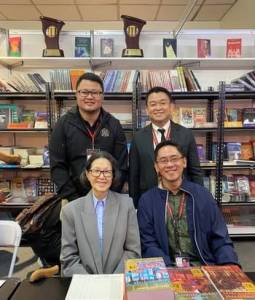
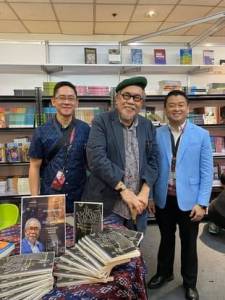
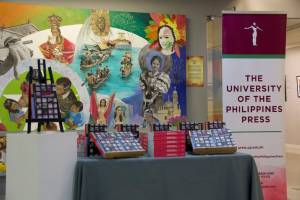
The University of the Philippines Press (UP Press) participated as one of the major exhibitors at the 2024 Manila International Book Fair (MIBF), held from September 11 to 15 at the SMX Convention Center Manila. As the Philippines’ longest-running and largest book fair, the MIBF has been a celebrated hub for book enthusiasts for over 40 years. It offers an unmatched reading experience by gathering the most extensive collection of books, magazines, comics, educational materials, and more under one roof.

For this year’s offering, the UP Press provided an exciting platform for readers to enjoy exclusive discounts, discover bargain finds, and connect with their favorite UP Press authors through book signings events.  Some of the authors who participated in the book signing events were National Artist for Literature Virgilio Almario, renowned author and columnist Butch Dalisay, pediatric neurosurgeon Ronnie Baticulon, and more.

Beyond showcasing local and foreign publishers, the MIBF featured a diverse range of exhibitors, including book printers, artist collectives, technology providers, art and craft suppliers, and other industry stakeholders.

The fair also offered a variety of engaging events, from author meet-and-greets to product demonstrations and discussions on the intricacies of publishing and bookmaking.

The UP Press remains committed to promoting Filipino scholarship, literature, and creative work, and its presence at the MIBF reaffirms its dedication to nurturing the country’s vibrant literary and publishing scene.

Posted on

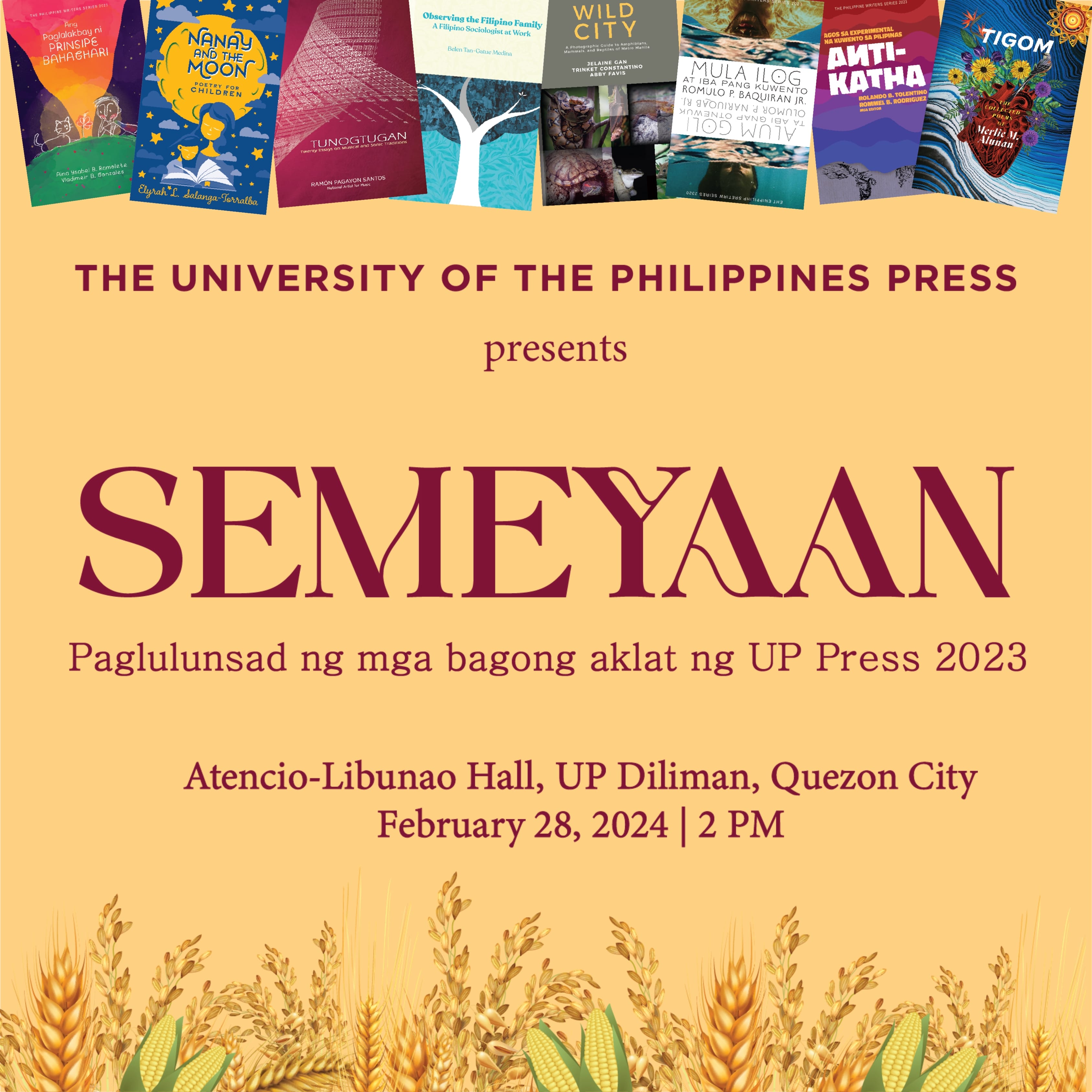
Semeyaan: Paglulunsad ng mga bagong aklat ng UP Press 2023.

The University of the Philippines Press is set to host a mass book launch titled Semeyaan: Paglulunsad ng mga bagong aklat ng UP Press 2023.  The event aims to highlight the titles published by the UP Press in 2023.

The term semeyaan is an agricultural tradition of the Erumanen ne Menuvu from Cotabato, Philippines. It is a thanksgiving ritual related to anticipating bountiful harvests and favorable weather. It also signifies a new beginning which is the hope of the UP Press as an organization as we prepare for our 59th anniversary.

Semeyaan happens on the 28th of February, 2pm to 5pm at the Atencio-Libunao Hall located at F. Agoncillo Street, U.P. Campus Diliman, Quezon City (please see attached e-invite below)

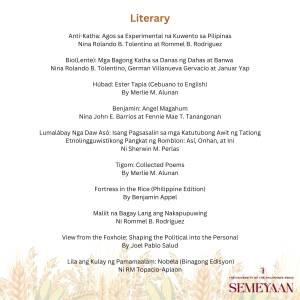
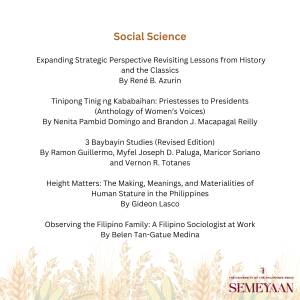
Here are the 31 titles UP Press launching tomorrow at the Semeyaan: Paglulunsad ng mga Bagong Aklat ng UP Press 2023!
Get these titles at a launch price in the venue, Shopee or Lazada stores!
February 28, 2024 | 2 pm
at the Atencio – Libunao Hall
F. Agoncillo St., U.P. Campus Diliman, Q.C.
See you there!


Posted on

UP Press at the 2023 UP Lantern Parade

Lulan ng payak na parol ng University of the Philippines Press ang representasyon ng tala at aklat—na kapwa nagbibigay ng liwanag. Sa nakalipas na limampu’t walong (58) taon ng UP Press, nakapaglimbag ito ng mahigit na sanlibong aklat na kumakatawan sa iba-ibang larangan ng arte at humanidades, agham panlipunan, siyensiya at teknolohiya, ekonomiks at managament. Naniniwala ang UP Press na ang mga aklat na ito ay hindi lamang nakapagbahagi ng mga bagong kaalaman at karunungan sa mga mambabasa. Bawat akto ng pagbabasa ay akto rin ng pagpapatalas ng isip at pagmumulat. Nakasalalay din dito, kung gayon, ang pagbuo ng panibagong lakas ng bayan.
 
Bitbit din sa ginawa nilang sombrero ang pabalat ng tatlumpu’t dalawang (32) aklat na nailimbag ng UP Press ngayong 2023. Ilulunsad ang mga ito sa unang bahagi ng 2024. Tara na’t magbasa, mamulat, at pag-ibayuhin ang panibagong lakas tungo sa bukas na laganap ang liwanag.


Kuha ni Alvin Encarnacion.
 
Posted on

Digital Cinema in the Philippines, 1999–2009

Author: Eloisa May P. Hernandez

Reviewer: Louie Jon A. Sánchez (Department of English, Ateneo de Manila University)

From Philippine Studies: Historical and Ethnographic Viewpoints

vol. 65 no. 4 (2017): 534–37

Copyright © Ateneo de Manila University

Eloisa May P. Hernandez’s Digital Cinema in the Philippines, 1999–2009 argues time and again for Philippine cinema’s continued life, albeit already in the contemporary era’s most transformative and indeed progressive form—the digital medium. Most critics and scholars decry the unending lackluster production of Philippine cinema in general, which logically has led to pronouncements of its death over the years. For Clodualdo del Mundo Jr., for instance, it seems to die over and over again in film scholarship. Hernandez, however, turns to the ever-altering digital medium to trace how it has provided Philippine cinema a new lease on life by radically transforming film production, distribution, and consumption from 1999 to 2009. The book is an important contribution to the already full-bodied corpus of film studies in the Philippines as it not only takes on the argument once again for Philippine cinema, but also properly assesses what has been continually marginalized by the hegemonic, consumer-driven mainstream cinema. The book lends history to Philippine digital cinema, and this narration seems to extend Philippine cinema’s lamented life. This is, I believe, what the book has carved in the still “growing field of Philippine film history,” as a work that aims “to proffer a more complex and dynamic study” of the said subject (16).

The book, which consists of a framing introduction, two comprehensive chapters on the history of digital cinema, and a short, summative conclusion, grew out of Hernandez’s dissertation on the subject at the University of the Philippines (UP) Diliman, under the able guidance of leading art critic Patrick D. Flores. Hernandez is associate professor of Art Studies at the College of Arts and Letters, UP Diliman, and a lecturer of Fine Arts at the Ateneo de Manila University. She earned her BA in Art Studies, MA in Art History, and PhD in Philippines Studies at UP Diliman. She is the author of Homebound: Women Visual Artists in Nineteenth-Century Philippines (University of the Philippines Press, 2004) and Sining ng Sineng Filipino (UP Sentro ng Wikang Filipino, 2009). She is a member of the Young Critics Circle Film Desk, once serving as its president.

Hernandez describes her book as “a culmination of more than a decade of engagement with Philippine studies, art history, film history, and Philippine cinema” (xiii). In studying over the course of its time frame “digitally produced full-length narrative films that have been screened in at least two public screenings: in a regular run or in alternative venues, and in local or international film festivals” (xiv), she traces the beginnings and trajectories of the medium in the Filipino context. She thus offers two periods in what she describes as the “technological history of digital cinema in the Philippines,” the period of introduction and the period of innovation (11), the subject of the book’s first chapter. In the second chapter, Hernandez strengthens her claims by building on her earlier historical and archival findings through a comprehensive map of the political economy of Philippine film culture, where digital cinema seems pervasive in production, distribution, and exhibition (thus, consumption). By way of the chapters on the history of digital cinema, the book illustrates the interrogations and negotiations by all of the stakeholders in the industry in the process of coming to terms with new technologies, responding to critical and popular tastes shaped by internal and external factors, and attempting to make the industry sustainable.

Hernandez offers a cinematic history in terms of “shifts,” which anchors her argument and considers the digital format as the next phase in an ongoing formal transformation “from celluloid to digital” (15). The book sports an optimistic look by zooming in on the exciting innovations brought about by digital films, which over the years have suffered from being ignored by the public, relegated to usually limiting platforms like high-end film festivals, and drowned by competition with the mainstream. In a way, Hernandez takes an “alternative” look, as it were, at Philippine cinema and shows how it managed to morph into a truly cultural medium by her careful archival synthesis of digital films and their contexts, as well as her critical engagement with the filmic notions of independence, which primarily defines the period of digitization in the Philippines. Hernandez’s most important stance on “independence” and the so-called “indie film” is best summed up as follows:

The emergence of digital cinema in the Philippines and its concomitant modes of production, distribution, and exhibition resulted in the shifting of definitions of “independence” in Philippine cinema. The notion of independence in Philippine cinema has always been fluid. It remains a contentious and debatable concept, a problematic nomenclature in Philippine cinema. (214)

This assertion, which appears toward the last few pages of the second chapter, comes after a sustained illustration of “independence” as it has been understood and practiced in Philippine cinema through the ten-year coverage of the book. It has also been shaped by the primary categories of production Hernandez has observed over the course of the period: “self-productions,” “artist-run production companies and creative partnerships,” “industry-based independents,” and “mainstream film companies, media conglomerate/network-based companies, and institutional support”—all deploying the digital medium to advance filmmaking in the country.

In effect, the book helps to curate and annotate digitally produced Filipino films, ranging from Still Lives (1999) by Jon Red, which Hernandez describes as one that “signaled the emergence of digital cinema in the Philippines,” to Bente (2009) by Mel Chionglo. A list of the said films is found in an appendix, with dates of exhibition as well as basic entries on direction and production. A cursory look at the appendix signals what came into the storytelling, the “heart,” of these films, despite being told in digital format—experimentals and speculations; Third-World paeans to technological progress (or lamentations about it); explorations on sex, gender, and performativity; metacriticism of cinematic and media forms and industries; and sharp social commentary, among others. These materials, avoided traditionally in the mainstream, have found form and ally in the digital format. While the mainstream persists in living out its consumerist dumbing down of the cinematic form, digital cinema in the Philippines, if we are to take Hernandez’s perspective, is indeed changing the whole industry one film at a time and for the better. It may be a slow process, but one by one these films the author mentions have provided new blood to the larger cinematic corpus, often and popularly understood in terms of star power and box office records.

In this book Hernandez makes a clear and bold statement for digital film, and the digital format, as the future of Philippine visual cultures. Despite its contemporaneity, she gives it a sense of history, and thus form, borne out of an industry’s need for a new lease on life, its search for “a more accessible and affordable filmmaking tool” (229), and its desire to contend not only with the technological advancements but also with the ever-changing viewing behavior of globalized Filipinos.

Posted on

RE: Recollections, Reviews, Reflections

Author: Luis H. Francia

Reviewer: Francis C. Sollano (Department of English, Ateneo de Manila University)

From Philippine Studies: Historical and Ethnographic Viewpoints

Copyright © Ateneo de Manila University

Multi-genre writer Luis H. Francia understands that compiling already-published works into a book may seem selfish. He had published an earlier collection, Memories of Overdevelopment (Anvil, 1998), which contained two decades’ worth of work. However, the reason he does it again is that he also understands its aesthetic value. RE allows readers who have followed Francia’s essays in various local and foreign as well as print and online publications throughout the years to “follow the arc of [his] writing” (ix). Even for these accustomed readers, but more so for new readers, that arc is surprising in its range and insight. Although the book conveniently and alliteratively classifies its contents into recollections, reviews, and reflections, the topics and treatment of the essays exceed the convention of these categories.

The collection starts with a brief interview with Salman Rushdie, who was supposedly hiding from Khomeini’s fatwa and Shiv Sena’s wrath. It is a revealing start since the book is full of those who have made indelible legacies in the arts, such as V. C. Igarte, Doreen Fernandez, Santiago Bose, and Nonoy Marcelo. To an extent, such legacies are built on the courage to represent truth as it is. Central among these personalities is Jose Garcia Villa, whom Francia considers to be a mentor and whose idiosyncrasies are well known. “Villanelles,” the essay about Villa originally published in The Anchored Angel (Kaya Press, 1999), presents an intimate but frank portrait of the poet: his dislike for Scotch, French food, and New Yorker poetry; his friendship with E. E. Cummings and Allen Ginsberg; and his New School workshop. The essay however ends not with the poet’s tastes but with questions, like afterthoughts after his death, about his relationship with exile and, à la Carlos Bulosan, America.

Because many of the essays come from Francia’s regular column in the Philippine Daily Inquirer, The Artist Abroad, a common theme in the book is the Filipino diaspora. Reading the book can feel like reading a travel journal (without the bland language of a guidebook) told from different personas: Filipinos in Manhattan, Madrid, Paris, and Hong Kong. These personas are set against contrapuntal narratives and surprising situations. For example, post-1986 Pinays in Hong Kong are set side-by-side with the ritual of the Tadtarin and Lino Brocka; and the Beatles beside Pete Lacaba watching a Pilita Corrales concert. These intertextual weavings are to be expected anyway given the historical provenance and social situation of the Filipino diaspora. But more than this, Francia not only reports scene and situation, a reportage whose perspective self-consciously comes from a writer in the diaspora himself, but also comments on their implications. In other words, Francia shows and tells. Endearing details, such as a Myanmar tour guide who eyes a Lonely Planet book and Atenistas visiting colegialas in Diliman, delight readers. However, the wonder of his essays is how they make every subject compelling and how they extend almost everything to a social critique.

The American empire is a frequent object of his critiques. Included in this volume are important essays from Vestiges of War, which Francia coedited with Angel Velasco Shaw (NYU Press, 2002), and Topography of War (Asian American Writers Workshop, 2006). Especially because the context of most of these essays is the post-9/11 world order, the ironies of empire and the pathos of the Philippine neocolonial republic are exposed. Francia reflects if, in the rhetoric and posturing in the “war on terror,” the aggressor has not in fact become what it seeks to defeat and whether the world has indeed become a safer place. Filipinos, especially seen in the sequence of neocolonial administrations in the Philippines, are complicit in this condition. The subtext of historical, economic, and political ties is too blatant not to be mentioned in the cases of Hacienda Luisita, the hunt for “terrorists,” and the elusive peace in Mindanao. Filipinos in the diaspora, therefore, are caught in a double-bind. Not only are they in a limbo of a journey (not fully departed, not fully arrived), they are also stuck in a “new world disorder” (192) in which their “homeland” ceases to promise home.

In addition to diasporic travel, the book also covers historical travel. José Rizal and the Marcoses have been favorite topics of Francia’s essays since the 1980s. This is also shown in History of the Philippines: From Indios Bravos to Filipinos (Overlook, 2010), which chronicles the formation of the nation through the layers of colonial and neocolonial influences. In RE Francia uses historical critique to contextualize his reviews and thicken the narratives in his personal essays. For example, in the review of David Byrne’s Here Lies Love, a musical about Imelda Marcos, Francia laments that catchy tunes and the pop psychologizing of a girl’s rags-to-riches story drown out her family’s corruption that bled a country dry. Of the last song reserved for the Imelda character, Francia is unforgiving: “Good music, wrong notes” (155). In another review, Francia calls William Pomeroy, a soldier who was part of Douglas MacArthur’s returning forces in Leyte in 1944, “more Filipino than many nationalists” (149). Pomeroy’s books, The Forest and Bilanggo (Prisoner), tell an autobiographical account of him and his wife, Celia, joining the Huks and their subsequent incarceration as political prisoners in the early 1950s. There is also a letter addressed to Rizal where Francia asks whether the hero holds the same views after more than a century of the hero’s death. Did Rizal, whose prophetic voice sparked the revolution and foretold the coming of other imperial powers in “The Philippines, a Century Hence,” see this far? Long are the heroes’ shadows in Francia’s expositions of recent events and present social problems. How would Bonifacio have continued the fight for democracy after 1986? What would Plaridel and the Gomburza have said about the Reproductive Health (RH) Law debate? It is not difficult to surmise Francia’s answers to these questions in his essays.

Francia is averse to power that is unchecked and abused. He writes about corruption in the military, bigotry in the Catholic Church, and publication censorship. The essay, “Pharisees in Manila,” has been controversial. Given that it was written during the high tide of the RH Law debate, the essay criticized the church’s gender bias and conservatism, making the institution irrelevant to many Filipinos. This same essay became the target of censorship of a university press, and the censorship became, in turn, the target of RE’s preface-postscript. For Francia these “political” issues are personal; the writer-memoirist-critic is, unavoidably, in the center of these issues. Family members even become characters in Francia’s social critique. In the earlier essay critical of the Catholic Church, Francia does not find it ironic to end with his late sister Myrna, an ICM nun of more than forty years. Although he does not know if his sister would have opted to become a priest, her progressive faith makes Francia believe that she would have been an excellent one. Francia also writes about his two lolo (grandfathers), Henry and Pepe, to rightly point out the impossibility of thinking of 1898 (war against Spain) without 1899 (war against the US). Henry, a US Army captain, and Pepe, a landed provinciano (man from the province), present a family history that is analogous to the eccentricities of Philippine history.

Nowhere in the book is Francia most personal than in his pieces about writing and the creative process. These essays, coming from talks for different creative writing classes and workshops, are expositions about various literary genres and how the writer recreates one’s self in the act of writing. A number of the essays explain the writing of Francia’s memoir, Eye of the Fish (Kaya Press, 2001), about exploration and self-exploration, about travelling through the islands of the archipelago and piecing together a self that is restless, unwieldy, and always incomplete.

As readers go through the range of topics, their reactions will be different: delighted, moved, provoked, and angered. But readers of this collection will always find a writer who mines from a cosmopolitan perspective a critical and reflective voice and concern for the country in this new century.

RE won the Best Essays in English award in the 35th National Book Awards in 2016.

Posted on

Contestable Nation-Space: Cinema, Cultural Politics, and Transnationalism in the Marcos-Brocka Philippines

Author: Rolando B. Tolentino

Reviewer: Joel David, Inha University

Posted in the International Journal of Asian Studies

doi:10.1017/S1479591416000267

In the final chapter of Contestable Nation-Space (hereafter CN-S), which is an evaluation of the cinema of Lino Brocka vis-à-vis the dictatorship of Ferdinand E. Marcos in the Philippines, Rolando B. Tolentino mentions some limitations in theories of national cinema and endeavors to provide a more useful framework by tweaking Aijaz Ahmad’s 1960s-based revolutionary orientation and Pathar Patterjee’s anticolonial and antistructuralist reconceptualizations (pp. 198–200). This turns out to be late in the game, inasmuch as in an intensive study the framework ought to have been stated at the beginning and refined along the way. The book relies on readers being sufficiently acquainted with the issues it raises and capable of filling in the missing elements. (CN-S contains six chapters comprising, in chronological order: “Articulations of Nation-Space,” “Working Concepts,” “Cityscape,” “Postnational Family/Postfamilial Nation,” “Mattering National Bodies and Sexualities,” and “[Third] Worlding Nation/Cinema.”)

In his conclusion, Tolentino summarizes the situation of Philippine national cinema, drawing lessons from preceding chapters and providing recommendations for its betterment. This is where the instabilities that beset CN-S reach their tipping point. For while relying on an intensive cultural-studies approach, Tolentino has disavowed auteurism (pp. 77–79), a method premised on the acknowledgment of the director’s artistic primacy in film practice, notwithstanding the entire book’s focus on a singular filmmaker. Since the book advanced no other alternative to the author-function, we can only read CN-S as one more of those “great-men” confrontations that old-line histories are already replete with.

More disturbing consequences arise from Tolentino’s rejection of the auteurist approach, aside from the fact that it leaves its cultural-studies insights suspended in the book’s idiomatic conceits, rather than rooted in Brocka’s (and his films’) manifold quirks and contradictions. CN-S was a product of Tolentino’s film studies in the US and was published during his term as Communications Dean at the national university and as concurrent chair of the Manunuri ng Pelikulang Pilipino [Filipino Film Critics Circle]. The latter group has come under increasing attack from independent critics, including former members, for its near-exclusive reliance on its annual award-giving ceremony as its primary means of validation. Personal disclosure: I have been referenced by the group, including Tolentino (2016), in the form of reprimanding a critique of the MPP that I had published (David 2013). As it is, Tolentino already happens to be the most highly qualified member of the circle and the most capable in terms of contemporary film discourse.

Tolentino’s refusal in CN-S to deploy auteurism could be ascribed to a corrective attempt on his part to temper the MPP’s awards-oriented proclivities. However, the study as a whole suffers immeasurably as a result. Tolentino revels in provocative premises, such as, in the introduction, by comparing the still-ongoing digital-independent cinema trend to the 1980s shawarma fad in Manila (p. 14), necessarily ignoring the fact that local shawarma, unlike digital films, have never been exported to the West. Several other attempts at allegorizations turn out to be more defensible than the shawarma analogy, but the book’s ideational (and physical) center, pivoting on Brocka’s city film Maynila: Sa mga Kuko ng Liwanag [Manila: In the Talons of Light] (1975), labors under Tolentino’s imposition of the concept of “capital infrastructuring” (p. 98), even though such a phenomenon could presumably abide without any film-text serving as confirmation. One reads on for the moment to see if Maynila itself can justify the use of the concept, but that point never arrives.

When Tolentino discusses Philippine political economy, he proceeds with a confidence that betokens deep interest in and preparation for the subject. When he then moves onto pop-culture territory, such confidence transmutes into an impatience for the material (which, after all, is regarded by orthodox Marxists as less vital to economic determinism). Truth be told, one could catalogue his errors of fact and perception and come up with an entire chapter of corrections. From one chapter alone (“Mattering National Bodies and Sexualities”), any local specialist could easily spot the following errors: the use of bomba [bomb] as a generic term for local sex films (p. 168), when in practice it refers to only the very first (occasionally hard-core) trend; the allegation that “Luz Valdez” as proper speak (where similar-sounding names are made to substitute for common words, in this case “lose”) arose from the actress’s popularity as villainess (p. 183), when in fact she was launched with, and has maintained, a wholesome image to the present; the avowal that the local slang word shoke [gay] was a portmanteau of “shota ay kelot” [his beau’s a man] (p. 184), when the latter expression was of more recent origin and shoke itself was derived from a corruption of shokoy [merman]. Most appalling of all is Tolentino’s contention that the use of the term “fighting fish” to mean Filipino pornographic movies came from the acronym MIFF, with people supposedly replacing the last two words of the early 1980s Manila International Film Festival with the euphemism (p. 171). A recent Google search turns up a declassified 1956 memorandum, ascribed to CIA operative Edward G. Lansdale, whose first description of fact states, “(A)n order of more copies of pornographic films (known in the message as fighting Fish [sic] film), has been received from Saigon from an American USIS employee” (Harper 2013).

Tolentino’s misimpressions of the Brocka films in his study evince certain shortcomings that auteurism, for all its excesses, would have corrected: he would have had to defer generalizing until he had seen all available Brocka films as well as the large volume of movies that either had influenced him or had been influenced by him; he would have had to anchor his findings in the formal properties of the specific Brocka texts that he opted to dwell on; and he would have had to focus more intently on the manner in which Brocka’s life, as the country’s most politicized and impassioned filmmaker, intertwined with his cinematic output. Tolentino’s difficulties become more congealed when he tackles the two projects that enabled Brocka to become an icon of independent production among several contemporary digital filmmakers: the epic small-town movie (Tinimbang Ka Ngunit Kulang [Weighed but Found Wanting], 1974) and city movie (Maynila, 1975) by the production company he set up after he bolted from an onerous exclusive contract with an established studio. In this instance Tolentino regurgitates conventional-left wisdom about the director as a messianic rebel, which he modifies by effectively positioning Brocka, David-like, against Marcos’s colossal monstrosity. In truth, Brocka may have been more of a Saul of Tarsus, whose first moral adversary was himself: he had started out as a reactionary oppressor, forbidding queer behavior (Velasco 1993, p. 31) and even conducting an anti-Communist witch hunt at the Philippine Educational Theater Association (Velasco, p. 36), where he became its virtual custodian after its founder left the Philippines as an anti-Marcos activist-in-exile.

Hence, when Tolentino mentions in CN-S that “Brocka was already making direct assaults” on the Marcos regime during the mid-1970s (p. 24), he overrides this crucial bit of information formerly known to only inner-left culture circles. But the films themselves reveal enough about the director’s then-conventionalist outlook, and account for his consecutive sweep of the establishment-controlled Filipino Academy of Movie Arts and Sciences’ annual awards. Although Tolentino describes Tinimbang Ka Ngunit Kulang (1974) as “antithetical to Marcos’s idealized society” (p. 28), the film can nevertheless be read as a parable on the need to replace a morally bankrupt traditional order with a newer and more enlightened still-patriarchal system; the same way that Marcos had envisioned his New Society as a rectification of the weaknesses of what he had termed the Philippines’s “sick society.” In the next year’s Maynila, Brocka’s standard angry young man follows a more progressive turn in finding himself victimized by big-city operators. Tolentino rightfully deplores the film’s use of a small-time Chinese merchant as a means of signifying foreign domination of the economy – a telling detail that Brocka continued to rationalize (Sotto 1993, p. 224) and that was carried over from the source novel of Edgardo Reyes (1966–67).

In the instance of Reyes’s denunciation of a Brocka-concocted sequence where the main character gets sidetracked into the demi-monde of male prostitution, Tolentino maintains that “contrary to the novelist’s open criticism of the film’s . . .‘making gay’ the story, Brocka differentiates the subculture from the feudal production by laying bare its transformative qualities” (p. 93). Unsurprisingly, Brocka’s own defense affirms his homophobic intent (Sotto, p. 225). Two matters contribute to Tolentino’s difficulties with Maynila, both of them proceeding from the probability that he may not have been able to watch (or remember) the movie’s original-release screening in July 1975. First, the rentboy sequence actually ran several times longer than it does in all current versions, definitely ending on an anti-queer note, with the main character expressing disgust toward his besotted hustler-mentor and walking out on the entire prostitution scene (David 2012, p. 29). Second, the original-release print opened with a title card that said “1970” – a detail that was duly noted in most of the major reviews of the time (see the reprint of Lumbera 1997, p. 200); by this means, Brocka had exempted the martial-law regime, which began in 1972, from the movie’s powerful social critique.

Despite his defensive posturing, Brocka apparently remained mindful of critical responses to these two early achievements and proceeded to correct the ideological shortcomings in these films and, subsequently, in his activism. In 1976, the year after Maynila, he made Insiang, which featured strong women characters surviving in the slums of the city (unlike the passive roles of women in Tinimbang Ka and Maynila); in 1979, he featured a sympathetic lumpen-proletariat character in Jaguar (a departure from the mobs that attempt to lynch the Other couple in Tinimbang Ka and that succeed in killing the main character in Maynila); in 1985, he positioned a strong-willed mother out to reclaim her son from a corrupt mayor in Miguelito: Batang Rebelde [Miguelito: Rebel Child] (in contrast with the madwoman still yearning for her cruel mayor-lover in Tinimbang Ka); in 1990, he depicted an educated and progressive Chinese family in Gumapang Ka sa Lusak [Dirty Affair]. His major crack at a queer-positive text, 1988’s Macho Dancer, was less successful than these other attempts; its gainful US distribution, however, encouraged him to plan a series of similarly themed projects that had to be finished by others after the fatal 1991 accident that cut short his career. After the 1983 assassination of an opposition leader Senator Benigno S. Aquino Jr., Brocka also began to take an active hand in the anti-dictatorship movement and wound up repudiating even the government that replaced it, for being insufficiently pro-poor (Velasco 1993, p. 37). His most overtly political films were produced at this time and would have been followed, had he survived, by increasingly ambitious, confrontational, and formally demanding works. A recognition of Brocka’s fullest measure could have been a cherishable aspect of any book that purported to tackle his films and their significances; unfortunately, Tolentino’s Contestable Nation-Space will not be such a volume.

REFERENCES
David 2013
David, Joel. “Pinoy Film Criticism: A Lover’s Polemic.” The Manila Review 3 (2013), pp. 6–8.
David 2012
David, Joel. “Thinking Straight: Queer Imaging in Lino Brocka’s Maynila (1975).” Plaridel: A Philippine Journal of Communication, Media, and Society 9:2 (2012), pp. 21–40.
Harper 2013
Harper, Lauren. “FOIAsourcing: The Lansdale Collection.” Unredacted: The National Security Archive, Unedited and Uncensored (6 December 2013). https://nsarchive.wordpress.com/2013/12/06/foiasourcing-the-lansdalecollection/. Accessed 20 July 2016.
Lumbera 1997
Lumbera, Bienvenido. “Maynila: Sa mga Kuko ng Liwanag: A Review.” In Revaluation 1997: Essays on Philippine Literature, Cinema and Popular Culture, pp. 200–203. Manila: University of Santo Tomas Publishing House, 1997. Originally published in Philippine Daily Express in 1975.
Reyes 1966–1967
Reyes, Edgardo. Sa mga Kuko ng Liwanag [In the Talons of Light]. Liwayway serialization, 1966–1967. Rpt. Manila: De La Salle University Press, 1986.
Sotto 1993
Sotto, Agustin. “Interview with Lino Brocka on Maynila: Sa mga Kuko ng Liwanag.” In Lino Brocka: The Artist and His Times, ed. Mario A. Hernando, pp. 223–26. Manila: Sentrong Pangkultura ng Pilipinas, 1993.
Tolentino 2016
Tolentino, Rolando B. “Hinahanap, Kaya Nawawala” [Searched For, Therefore Missing]. Contribution to “A Round Table Discussion on Poetics and Practice of Film Criticism in the Philippines.” Ed.
Patrick F. Campos. Plaridel: A Philippine Journal of Communication, Media, and Society 13:1 (2016), pp. 178–84.
Velasco 1993
Velasco, Johven. “Brocka’s Theater: Something from the Heart.” In Lino Brocka: The Artist and His Times, ed.
Mario A. Hernando, pp. 23–37. Manila: Sentrong Pangkultura ng Pilipinas, 1993.